Lurking at the ATM

Unlike many other countries, an expat without a national ID number — which here is called a DNI (Documento Nacional de Identidad) — will have a very hard time opening a bank account in Argentina. (You cannot get a DNI without having some sort of resident visa.)

I have read tales online of a few rare expats who have managed to open a bank account without the DNI, but it appears to be exceedingly difficult. We considered trying to go that route, but the funny thing is, even if you can swing an account, everyone tells you not to put any money in the Argentinian bank because the government could seize the money and devalue it at any moment, a la 2001 (“the crisis,” as it is called here). We decided not to bother.

Most expats here without a DNI just lurk by the ATM machine, gathering cash every day and hoarding it to pay for rent and other bills.

It works like this: a) You can take out about 600 pesos per transaction at an ATM machine; and, b) You can only take out the equivalent of $US 500 per day total from all ATM transactions in a 24 hour period (about 1,680 pesos by today’s exchange rate).

Cash economy baby.
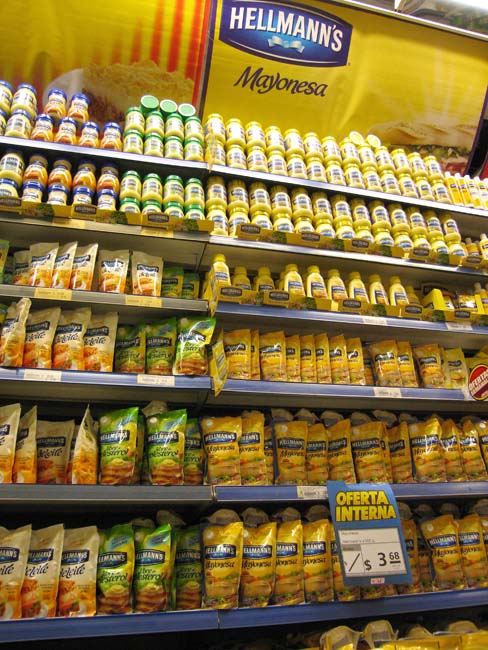
Wall O’ Mayonnaise

Here is a picture of the mayonnaise display at the local COTO supermarket. I think it speaks for itself and the Porteño love of all things mayonnaise–after all, it is the perfect sauce that compliments a wide variety of foods…even Caesar salad!

Departamento (Apartment) Decisions

You have two options when renting here in Buenos Aires:

Option 1: Unfurnished Long-Term Rental. With this type of rental, you generally sign a 24 month lease and are required to have a garantía. (A local person who provides a guaranty. Said local person must own property in Capital Federal, the inner city, if that’s where you are renting an apartment.)

We have decided to abandon option 1, even though we are very lucky to have a person willing to act as a garantía for us. At the end of the day, after purging so much of our crap back home, I cannot justify coming here and furnishing a three bedroom apartment–dishes, linens, refrigerator, washer/dryer…for only a year or two.

On top of that, shopping in a new country sucks up a tremendous amount of time and energy; we’re exhausted just getting everything together for the girls’ school, I can’t imagine having to furnish a place for Ian, Tom, me and the girls. I nearly went into apoplexy the other day just thinking about it.

Option 2: Furnished Temporary Rental. This is the direction in which we will focus our apartment hunting resources. Yes, it’s more expensive up front, but it’s less of a hassle, doesn’t require a garantía, and, once you add up all of the costs of Option 1 (utilities, Internet, taxes, gas and outfitting a new apartment), I suspect we certainly won’t be losing money.

So the new, new, new plan is to move into a temporary rental closer to Belgrano and the Z’s school until the end of the school year (early December). Then we will abandon all apartments in Baires, instead turning to travel during the summer, when we hope to explore Uruguay, Mendoza, Patagonia, and Iguazu Falls (while our fellow Oregonians are getting soaked in the rain)!

In February, we’ll come back into the city, rent another temporary apartment, and the girls will begin school at the end of the month.

Recycling in Buenos Aires

Portland recycling habits die hard.

We are used to separating out all paper, cardboard, glass, plastic; we are used to composting. It is disorienting to just throw everything out with the trash.

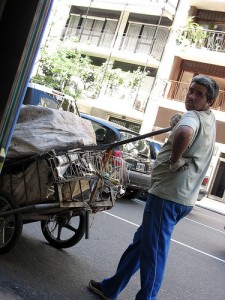
Actually, there is some limited recycling in Baires, and it is accomplished by the “carteneros,” one of whom is pictured here. They are are private citizens that go through the trash and separate out some glass and some cardboard to resell on their own. They often wheel around their inventory on very large carts, with many close calls on the streets between the larger carts and the taxis and buses.

After talking to Ian’s friend Guadalupe, we are now trying to separate items in our trash for the carteneros to make it easier for them to recycle.

Photo by Flickr user nbreazeale used under a Creative Commons license.

Expatriate with Kids

This stint in Argentina is my second foray spending an extended period of time overseas as an expatriate. The first time around, I was just out of college and spent four years overseas–three in Asia working for an aerospace corporation, and one in Europe, well, just messing around.

Some might think that being an expat with kids makes the experience harder, but there are many positive inputs that the wee ones bring to the adventure!

PROS OF BEING AN EXPAT WITH KIDS

  • You do not get profiled as terrorist/drug smuggler/shoplifter! We can carry backpacks into stores and no one looks at us twice. We arrived in Argentina with a MOUND of bags and got waived right through customs. Back when I was a single and very young international traveler, I apparently fit every profile, because I was stopped by immigration, customs, and security guards constantly.
  • Kids give you a social construct. When you first move overseas, it can be difficult to meet people and you may be tempted to hide out in your apartment all day (especially with Internet access). Well, with kids, it’s not possible to hide out in your apartment (they would drive you bonkers if you tried). Having to find schools, uniform stores, field hockey stores, seamstresses to repair ripped uniforms, birthday party presents, and having to meet parents, arrange play dates, negotiate sleep overs, etc. really makes you jump into local culture and language with both feet!
  • You have extra carrying hands. I’ve never owned a car while living overseas, so having extra carrying capacity from the grocery store, or any other store, is HUGE (even if it comes with whining).
  • You eat healthier. If the girls weren’t here, I think that Tom and I would be living on gelato and alfajores (a yummy crisp butter cookie sandwiched around a dulce de leche caramel center).

Mini Garage Doors for Windows

Okay, perhaps these are not the most attractive exterior adornments for windows, but they work really well!

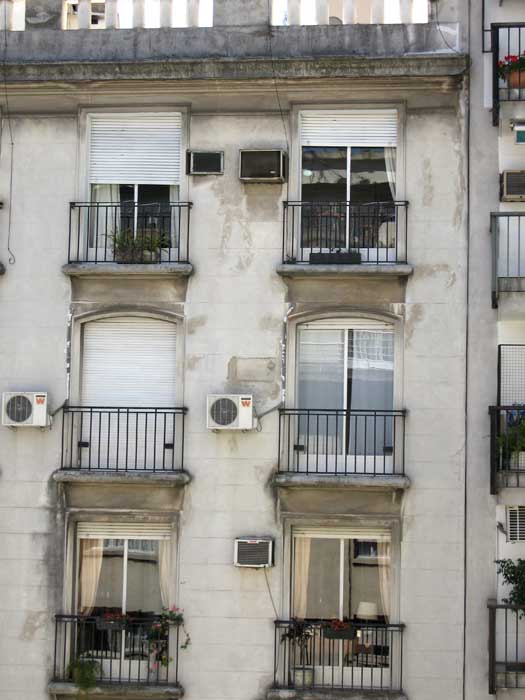
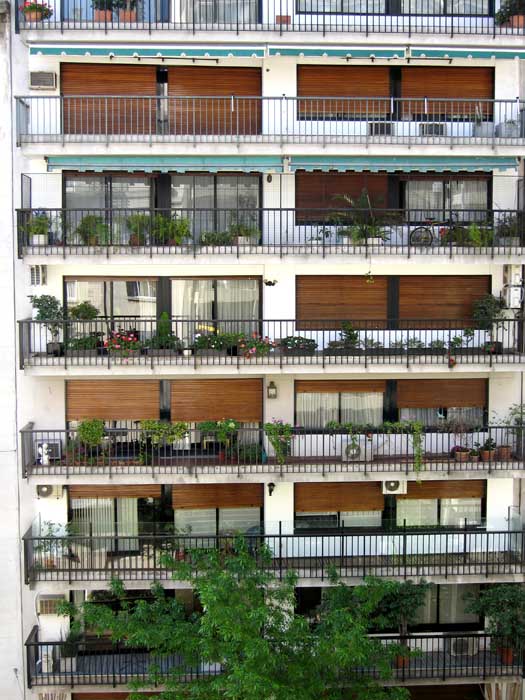
Click on the pictures below for a better look at the shutter systems that you find on nearly every apartment building in Baires and that I call “garage doors for windows.” The shutters are usually white or wood colored, as shown in these photos.

On the inside of every window there is a manual or electric control that allows you to manipulate the shade (garage door) to any position you wish. You can close the shutters down completely, with no gaps between, resulting in a very dark room. You also can lower them all of the way, but leave gaps between each horizontal slat in the shutter, which gives you privacy and light at the same time. They insulate the apartment from the heat when lowered completely, an important feature since many of these buildings have single-paned windows.

Things Are Going All to Hell

Wow, we’ve had quite a run of luck here lately!!

1) Huge Leak. We turned the air conditioner on in our room two nights ago, and it leaked all night long with a steady fast drip down the wall. We awoke to a huge puddle on the floor! *Sigh*

2) Door Knob Broke Off. Last night, Ian dashed out to make the late-night gelato run and the door knob on the apartment literally came off in his hand. It is a very old door, and the area the knob was screwed into has been so abused over the years, there isn’t really anything left for the screws to bite. Double *sigh*.

(No one has come yet to fix either problem–but that is to be expected.)

3. Ants. We have an ant infestation (on the positive side, they are the cutest little ants I have ever seen). Today, we got home from running errands and it looked like we had an ant party in the kitchen. So far, the apartment managers have left us a can of Raid to deal with it–something I love spraying around my kitchen!! I would give my kingdom for some of those ant traps they have in the US.

4. No Ballots. Tom and I are having a hell of a time getting our ballots. (It’s a long story.) Suffice to say, I am currently sitting by my open window on the 5th floor of my apartment building, leaping up at the sound of any vehicle outside of my place to see if it is the Fed Ex truck. (I have low expectations since this is the same driver who said I wasn’t here an hour ago…)

Argentine Grand Prix Bus Drivers

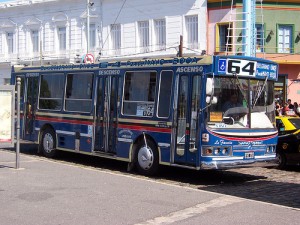
I love that Argentinian bus drivers all conduct their vehicles as if they were driving taxis…very small taxis.

They dart in and out of traffic nimbly, like a taxi. They accelerate and decelerate like a carnival ride, and like a taxi. They straddle all of the lane lines, like a taxi. There seem to be as many of them on the road as there are taxis. They stop every couple of blocks on their routes, but in between every stop, the enormous buses manage to dart across three to four lanes of traffic from the extreme left to the extreme right of whatever avenue they are driving.

The bus system is chaotic and decentralized, and the buses themselves spew a noxious mix of black exhaust; however, I must applaud the lack of a hub and spoke system. The decentralized nature of the buses means that you can catch a bus from somewhere near your home and go to within a few blocks of pretty much anywhere in the city.

Photo by Flickr user monkey.cl used under a Creative Commons license.

First Day of School in Argentina

Considering the fact that both of their sweat pants ripped in the crotch while stretching during field day, the first day of school went rather well indeed!

At pick up, Zelda didn’t even mention the fact that her sweat pants had torn. Zoe was a little peeved, but mildly so. Zelda declared the first day to be fabulous. She said that she had made new friends, learned new playground games (color witch–a version of tag) and worked on her Spanish numbers.

Zoe had taught somebody the singing/hand game “say say oh playmate,” and ended up having to play it for an hour! She also did some writing in Spanish and received a nice card from a girl named Vicky in English class saying she wanted to be Zoe’s friend.

After school today, we dragged them to a shoe store to pick up the brown shoes they need for the uniform day tomorrow. We also picked up something for them to use as lunch boxes and got the paper and colored pencils the girls needed. Next, we will have to see if we can have the sweatpants repaired–sigh. Not something we factored into our schedule this week.

So far so good! What a relief.

Desperately Seeking Caesar

When we first arrived and were not eating dinner on an Argentinian schedule (i.e., at midnight), we would often stop in to a cafe to eat our evening meal. Several times, we attempted the Caesar Salad.

This was folly though–thus far, it has not been the salad for which we hoped. Here, it often contains ham, or chicken, or chunks of cheddar cheese, or hunks of an unidentified white cheese, or hard boiled egg…all topped with masses of an artfully arranged heavy mayonnaise dressing.

Still craving a more traditional Caesar salad, we decided to make our own while entertaining guests for the first time last night.

Sounds easy, you don’t need a lot of ingredients, but getting romaine lettuce proved to be both expensive (in cab fare) and time consuming. First I checked at my verduleria (local produce seller)–the lettuce there was so limp, I couldn’t believe that they were trying to sell it. I ran to the Disco (local grocery). Same thing–the entire head would fall over in my hand if I tried to pick it up.

I hopped a cab and rode 20 minutes to an open air market in Belgrano. No luck, it was closed. So I started walking around Belgrano until I found a Carrefour, another supermarket, and bought what seemed like every head of lettuce in the place. (The check-out guy gave me the “crazy foreigner” look.) We stripped off a lot of slimy limp outer leaves and, hooray, discovered some yummy, actually crunchy, bright green romaine lettuce on the inside, just waiting to get out.

I’m happy to say that we were able to serve a decent Caesar salad to our first Argentinian dinner guests (not counting Ian, of course).

Our guests were Sara King, who is here in Argentina from Portland visiting the city for a few months, and Ian’s friends, Dani and Guada. (Guadalupe brought us home-baked alfajores–sort of a butter cookie with dulce de leche in the middle–yummy.)